


























Views
Downloads
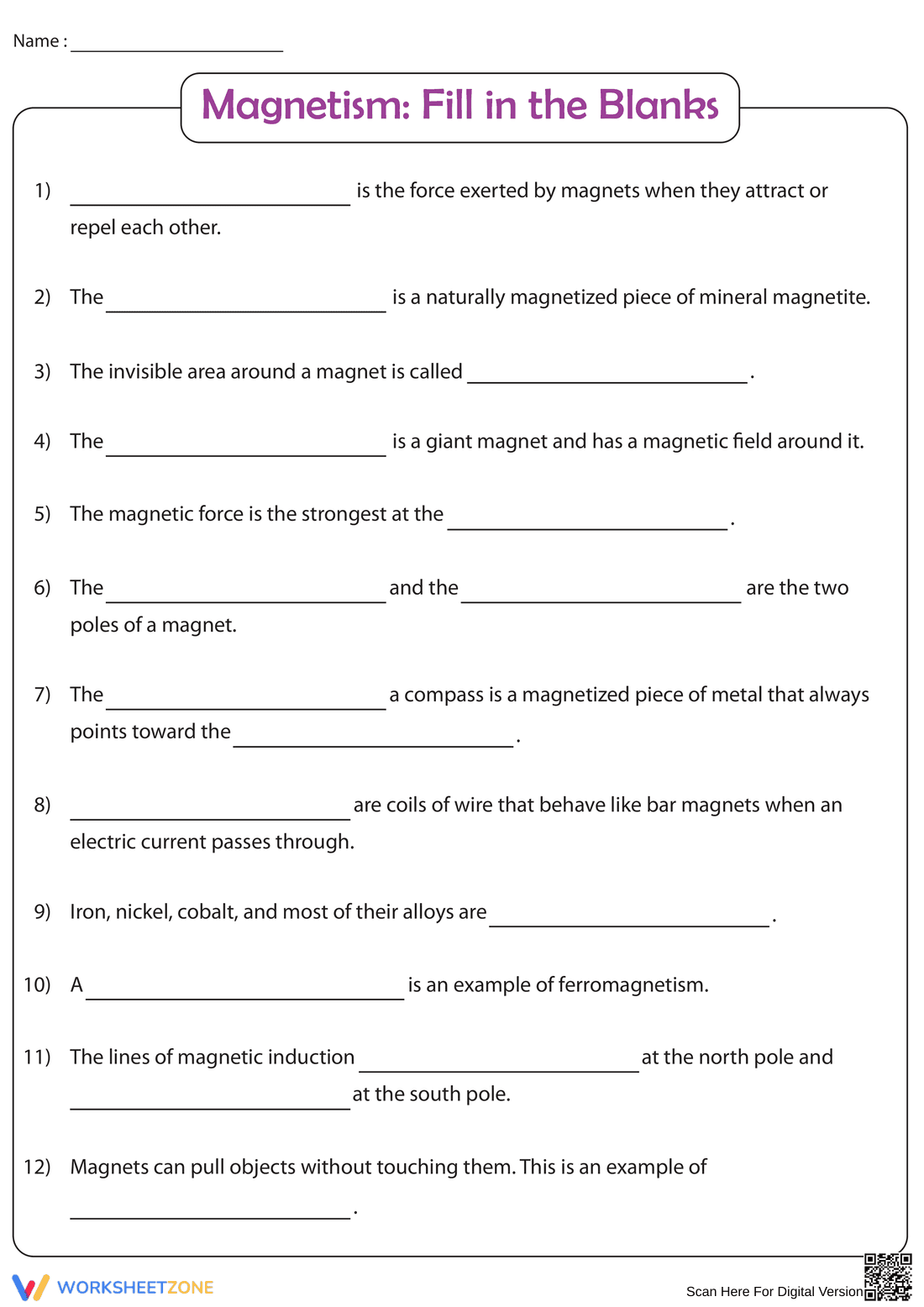

Printable Magnetism Worksheet | Grade 6 & 7 Science
Paste this activity's link or code into your existing LMS (Google Classroom, Canvas, Teams, Schoology, Moodle, etc.).
Students can open and work on the activity right away, with no student login required.
You'll still be able to track student progress and results from your teacher account.
This comprehensive magnetism worksheet reinforces core physical science concepts through structured vocabulary practice. Students identify key terms related to magnetic fields, poles, and induction to demonstrate their understanding of non-contact forces. This activity ensures learners can articulate how magnets interact with various materials and the Earth's magnetic field with accuracy.
At a Glance
- Grade: 6-7 · Subject: Physical Science
- Standard:
MS-PS2-5— Provide evidence that magnetic fields exist between objects exerting forces- Skill Focus: Magnetism Vocabulary & Concepts
- Format: 1 page · 12 problems · Answer key included · PDF
- Best For: Independent practice or quick formative assessment
- Time: 15–20 minutes
What's Inside
This resource features 12 carefully crafted fill-in-the-blank sentences that cover a wide range of magnetism topics. From the fundamental properties of magnetite to the complex behavior of lines of induction, the worksheet provides a thorough review of essential terminology. The single-page layout is optimized for clarity, and a full answer key is provided to facilitate rapid grading or student self-correction.
Zero-Prep Workflow
- Print (1 minute): Download the PDF and send it to your printer; the layout is ready for immediate distribution without any formatting adjustments.
- Distribute (1 minute): Hand out the sheets to your Grade 6 or Grade 7 science class as a bell-ringer, exit ticket, or homework assignment.
- Review (5 minutes): Use the included answer key to quickly check student progress or lead a whole-class review to address any misconceptions about magnetic forces.
Total teacher preparation time is under 2 minutes, making this an ideal resource for sub plans or busy classroom schedules.
Standards Alignment
This worksheet is aligned with MS-PS2-5, which requires students to provide evidence that fields exist between objects exerting forces on each other even though the objects are not in contact. By identifying concepts like the magnetic field and induction, students build the vocabulary necessary to describe these invisible interactions. Both standard codes can be copied directly into lesson plans, IEP goals, or district curriculum mapping tools.
How to Use It
Assign this worksheet during the "Explain" or "Evaluate" phase of a 5E lesson cycle to consolidate learning after a hands-on lab with bar magnets and iron filings. Teachers should observe students as they complete the section on magnetic induction to identify those who may need additional scaffolding with abstract field concepts. Completion typically takes 15 to 20 minutes depending on prior knowledge.
Who It's For
This activity is designed for middle school students in Grade 6 and Grade 7 who are exploring electromagnetism. It provides excellent support for English Language Learners by focusing on precise technical vocabulary. It pairs naturally with a classroom anchor chart showing magnetic field lines and a hands-on demonstration of Earth’s magnetism using a compass.
According to the RAND AIRS 2024 report on science literacy, the use of structured vocabulary reinforcement in middle school significantly improves long-term retention of abstract physics concepts such as non-contact forces. This Magnetism Fill in the Blanks worksheet is specifically designed to bridge the gap between hands-on experimentation and academic terminology, aligning with MS-PS2-5 by requiring students to identify the mechanisms of magnetic fields and induction. Research indicates that when students can accurately name the components of a phenomenon—such as the roles of poles, solenoids, and ferromagnetism—they are better equipped to construct evidence-based arguments during higher-order inquiry tasks. By providing 12 targeted problems that move from basic definitions to complex interactions, this resource supports the scaffolding necessary for mastery in physical science. The inclusion of a clear answer key further supports formative assessment strategies, allowing teachers to pivot instruction based on real-time data from student responses.


